
Kauaʻi County Criminal Docket Searches
Start with eCourt Kōkua, the state's public system and the first stop for a Kauaʻi County criminal docket. Got the full case ID? Use Case Search. With only a name, run Party Search. Filter to the Fifth Circuit plus criminal case type. Open the case, confirm the court and filing date, and select Case Dockets, where entries run oldest to newest. The latest order, minute, or hearing notice carries the most weight.
- Accept the official disclaimer and complete CAPTCHA if shown.
- Search by full case ID, or use a carefully narrowed party name.
- Confirm Fifth Circuit, criminal case type, filing date, and status.
- Compare Case Dockets with Hearings, Charges, Dispositions, bond, and financial tabs.
- If the case is missing, use the correct clerk email, phone, counter, terminal, or written request.
Hours are limited: Monday through Saturday from 4 a.m. to midnight HST, and Sunday from noon to midnight HST. A blank screen can mean a misspelled name. It can also mean an old case ID, the wrong court filter, or a sealed and confidential file. A no-result screen never proves that no case exists. The broader Kauaʻi docket search page explains both modes.
Kauaʻi Criminal Courts by Offense
Criminal jurisdiction here splits by case type. No county clerk or city court runs it. The Circuit Court of the Fifth Circuit holds the felony cases and the jury trials. The District Court of the Fifth Circuit handles misdemeanors and can open a felony case before transfer or commitment. Family Court keeps its own criminal matters. Every branch leans on Hawaiʻi State Judiciary clerks and eCourt Kōkua.
| Kauaʻi court | Criminal docket role | Record route |
|---|---|---|
| Circuit Court | Felonies and general criminal trial work | LegalDocs.5CC@courts.hawaii.gov |
| District Court | Misdemeanors and initial stages of some felony matters | CopyRequests.5DC@courts.hawaii.gov |
| Family Court | Criminal matters within its jurisdiction | LegalDocs.5CC@courts.hawaii.gov |
The split matters most when a filing has no PDF icon. Circuit and Family requests go to one branch. District criminal requests go to another. Puʻuhonua Kaulike puts all of these offices under one state courthouse roof, but the case-level route still decides which staff pull and copy the file.
Criminal Dockets: What They Show
A Kauaʻi County criminal docket is a timeline. It tracks the case ID, court, filing date, charge, parties, public counsel, hearings, plea, disposition, sentence, custody or bond data, financial assessments, and appeal entries. Each line records an event in the file. It is not the whole filing. A PDF icon marks a public image that can be purchased online. No icon can mean the image is unavailable or restricted.
| Case ID | The Judiciary identifier used for the most exact search. |
|---|---|
| Charge | Alleged offense, statute, and classification. |
| Case Dockets | Dated filings, minutes, orders, and events in sequence. |
| Hearings | Date, time, type, and location when public. |
| Disposition | The recorded outcome of a charge or case. |
The official Judiciary code list supplies Hawaiʻi’s local vocabulary.
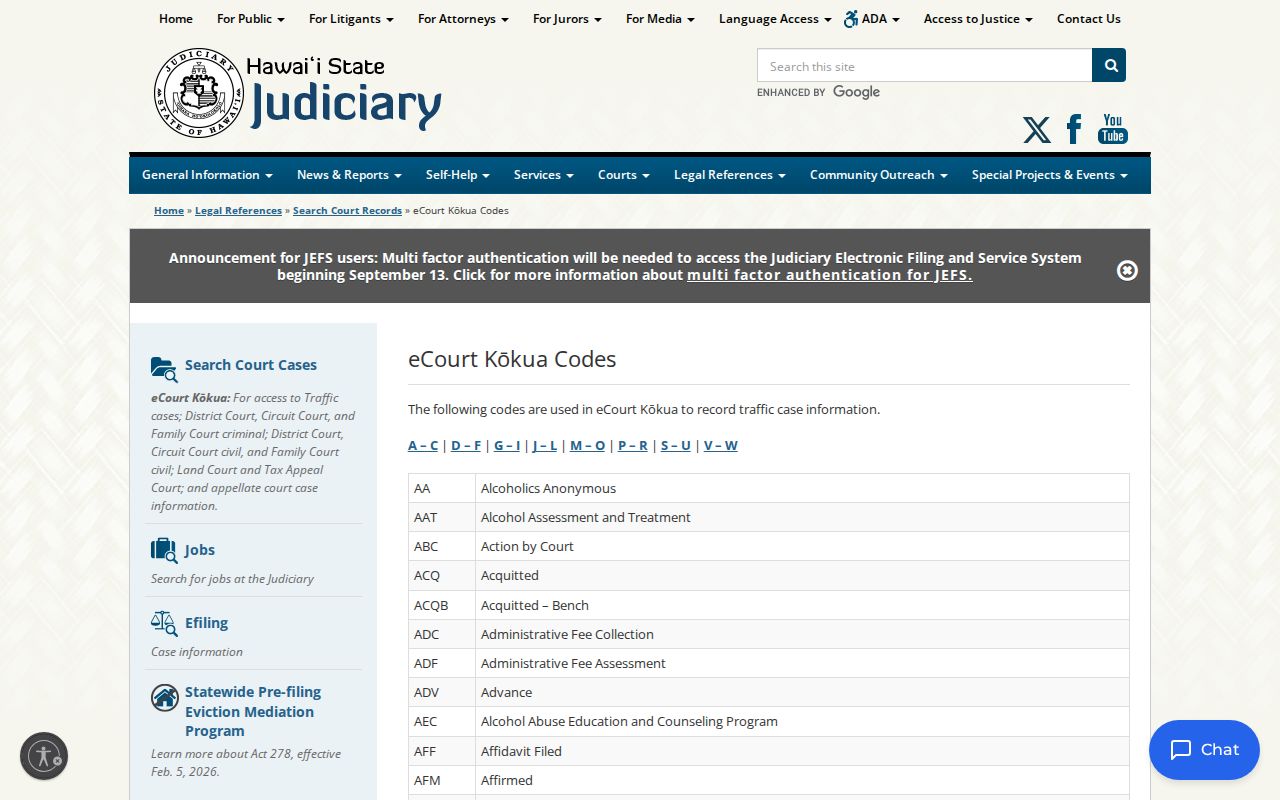
Follow each Kauaʻi entry's wording, not another state's shorthand.
Kauaʻi Criminal Complaint Codes
DCRF opens a Criminal Felony Complaint, and DCRM opens a Criminal Misdemeanor Complaint. Those codes flag the track. They name the complaint, not guilt. Expect later entries such as an information or indictment, arraignment, plea minutes, motions, custody events, or a disposition.
- DCRF
- Criminal felony complaint, often tied to the Circuit Court path.
- DCRM
- Criminal misdemeanor complaint in the District Court path.
- FTA
- Failed to Appear, an event rather than a final outcome.
- Bond
- Money or conditions meant to secure appearance, not decide the charge.
Read each code beside the court, date, charge, and later events. Complaints change. A case can be amended, transferred, dismissed, resolved by plea, or tried. A custody or FTA line can matter. It is not the result. The Dispositions tab supplies the endpoint.
Criminal Case Stages on the Docket
A Kauaʻi County criminal docket grows with the case. A complaint usually opens it. Appearance and plea follow, with bond, custody, and release conditions often close behind. Pretrial motions, notices, and continuances fill the middle. Resolution arrives as a plea, trial result, dismissal, or deferred acceptance. Sentencing and financial entries follow. An appeal can spawn its own appellate case ID.
Docket flow: Filing → Arraignment → Pretrial → Plea or Trial → Disposition → Sentencing
Do not assume the last hearing was the trial. Nor does the first disposition-sounding word end every charge. A case can carry several counts, each with its own result, so compare the chronological entries against the charge, disposition, sentence, and appeal fields.
Kauaʻi Criminal Dispositions Decoded
Hawaiʻi's disposition codes are exact. FNG means found not guilty, and DSM means the case was dismissed. DNP signals the prosecution dropped the matter. DPJ means dismissed with prejudice, DWO means dismissed without prejudice, and a bare "dismissed" label never tells you whether refiling is barred.
| Code | Meaning | Safe reading |
|---|---|---|
| FNG | Found Not Guilty | A merits outcome. |
| DNP | Dismissed Upon Nolle Prosequi | Prosecution no longer pursues it. |
| DPJ / DWO | Dismissed with / without prejudice | Clarifies refiling effect. |
| DAG / DNC | Deferred acceptance of guilty / no-contest plea | Not an immediate conventional conviction. |
| FTA | Failed to Appear | An event, not final disposition. |
The Judiciary interpreter program describes language help for proceedings.
Interpreter access supports court participation, while the written docket remains the official sequence.
Kauaʻi County Criminal Docket Courts
The Puʻuhonua Kaulike Building at 3970 Kāʻana Street in Līhuʻe serves as the Fifth Circuit's one courthouse hub. Circuit felony work and Family Court matters sit alongside District misdemeanors there. Criminal traffic and legal-document operations are organized there too. The main Circuit Court number is (808) 482-2300. For criminal misdemeanors, DUI, DLNR citations, and leash-law matters, call the Courtroom 2 clerks at (808) 482-2645. The Fifth Circuit page lists (808) 482-2330 for record requests. Fax is (808) 482-2553. Older files may sit off site. Call first with the case ID and ask whether retrieval is needed. A public terminal offers free review on screen. Copies still cost money. Mail and written Court Records Rules requests remain open once the proper branch confirms custody and payment.
Note: For questions about a pending Kauaʻi criminal docket entry, setting, or record, ask the clerk staff. Never ask a judge.
Kauaʻi Criminal Docket Filing Mix
How busy is the Kauaʻi criminal docket? The Criminal Justice Research Institute counted 1,391 criminal filings in the Fifth Circuit for FY2025. That works out to roughly 116 new cases each month. Petty misdemeanors made up 45 percent of the most-serious-offense mix. Misdemeanors accounted for 29 percent. Class C felonies were 19 percent, class B felonies 6 percent, and class A felonies 1 percent. Read these as filing categories only. The numbers say nothing about convictions or how many distinct people were charged.
The spread shows why a Kauaʻi court docket search needs both the District and Circuit routes. It cannot tell you whether a specific case ended in guilt, dismissal, or acquittal. For that, you have to pull the individual docket itself.
Access Rules for Criminal Dockets
Hawaiʻi treats most court records as open by default. That rule comes from the Hawaiʻi Court Records Rules. Even so, confidentiality rules, redactions, sealing, and access procedures still limit what you can see. The Case Dockets index may cost nothing. A linked filing image can carry a charge. Public terminals let you review records on screen for free. One caution: a written request cannot override a statute or a court order.
Key access rules:
HRS §92F-11 states a general presumption of government-record access unless law restricts it.
HRS §571-84 restricts public inspection of specified juvenile and family records.
The juvenile-confidentiality source is shown below.
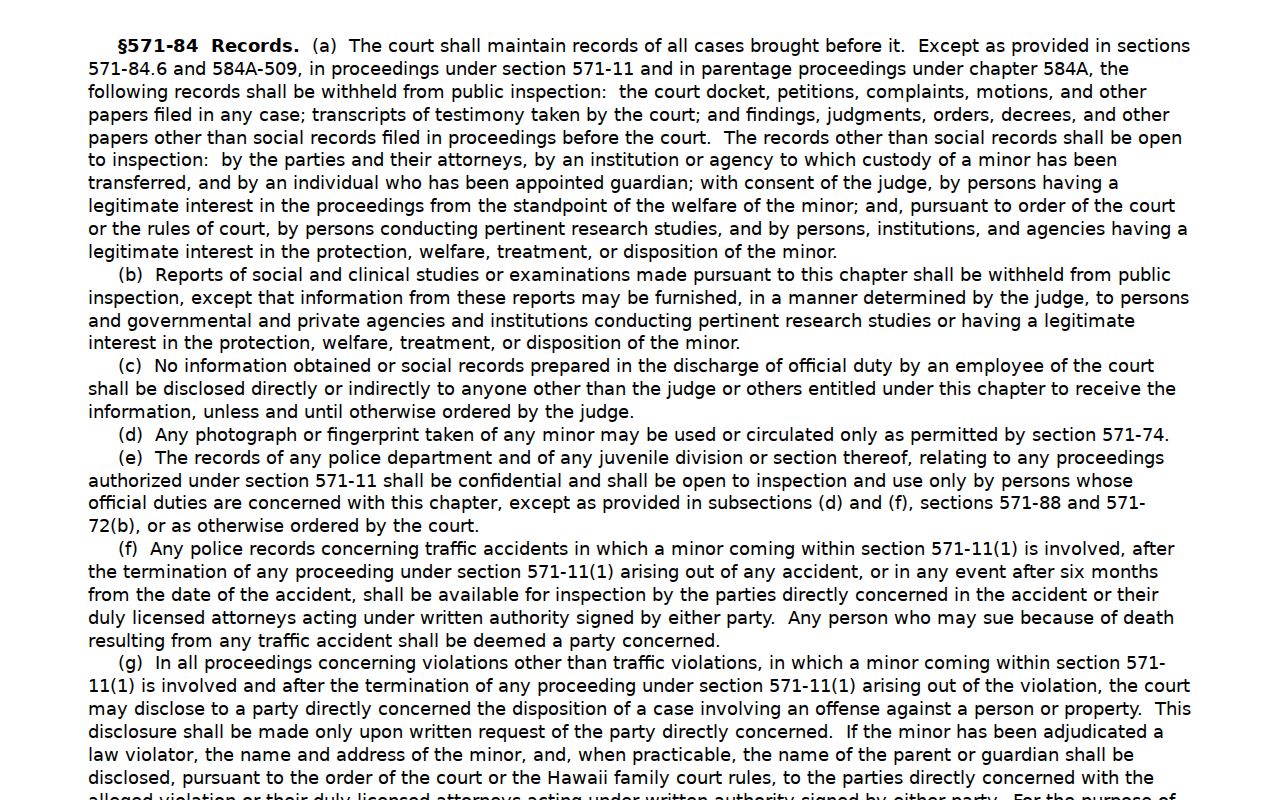
A blank result in a docket search can simply mean the law blocks access. Ask the right branch whether the case is old, sealed, or confidential before assuming anything. Special access, though, usually takes legal authority or a court decision.
Kauaʻi Drug Court Docket Codes
Kauaʻi’s Fifth Circuit handles drug-court functions within its problem-solving approach. Yet the court offers no separate public specialty-docket search. The case stays under its regular criminal or Family Court ID. Two abbreviations matter here. DCP stands for Drug Court Program, and DAC stands for Drug Assessment Collected. Each code marks an event on the docket, nothing more. It reveals no confidential clinical details. It proves no eligibility either.
Think of specialty court as a supervised case track. It is not a separate court level. Search the same criminal case ID, then scan Hearings for public settings. Confirm details with the court. No single docket line will tell you program admission, length, or private treatment information. Whatever access rules govern the underlying case still apply.